FM radio remains one of the most reliable and substantially used conversation generators globally. Despite the short boom of virtual media, FM broadcasting continues to play a crucial role in delivering music, information, enjoyment, emergency signs and symptoms, and network facts to tens of tens of millions of listeners each day.
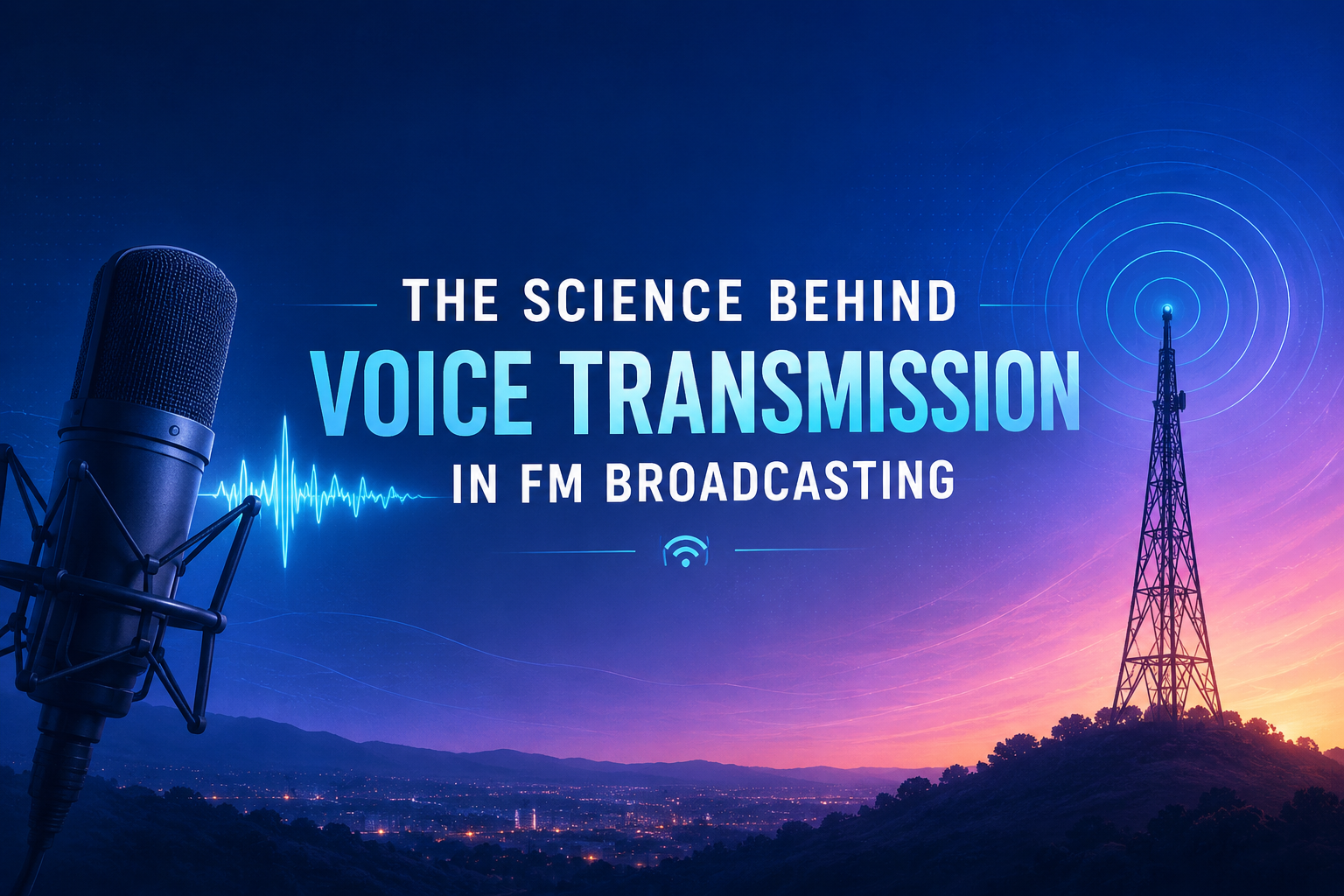
Understanding the science behind voice transmission in FM broadcasting permits delivering a motive of ways a human voice travels from a studio microphone to radio receivers in towns and areas. The manner includes sound wave conversion, sign processing, frequency modulation, radio frequency transmission, and reception era jogging, collectively and seamlessly. This article explores every aspect of FM voice transmission and the scientific thoughts that make it feasible.
What Is FM Broadcasting and How Does It Work?
FM stands for Frequency Modulation, a broadcasting approach wherein the frequency of a radio provider wave modifies in step with the audio signal being transmitted. Unlike AM (amplitude modulation), FM offers advanced sound that is extremely good and extra resistant to noise interference.
The primary FM broadcasting manner begins to evolve at the same time as a voice or audio delivery is captured by using a microphone. The audio signal is then processed, modulated onto a radio frequency provider wave, amplified, and transmitted through an antenna. Listeners gather the signal through FM radio receivers, which decode the data and reproduce the real sound.
Why Is FM Broadcasting Preferred for Audio Transmission?
FM broadcasting gives first-rate sound fidelity, making it first-rate for tune and voice transmission. Since statistics are carried through frequency versions in preference to amplitude changes, outside electric noise has a first-rate deal; it impacts the signal greatly much less.
This advantage lets in FM stations to deliver clearer audio over a massive insurance vicinity. As an end result, the FM era stays a preferred desire for employer radio stations, community broadcasters, and public broadcasting networks internationally.
Understanding Sound Waves: Foundation of Voice Transmission
Before exploring the science behind voice transmission in FM broadcasting, it’s miles more vital to understand sound itself. Human speech consists of sound waves created with the useful resource of the use of vibrations of the vocal cords. These vibrations tour through the air as stress waves.
When someone speaks right into a microphone, the microphone captures these pressure versions and converts them into electric indicators. These electric representations keep the frequency, amplitude, and traits of the real voice, allowing them to be transmitted electronically.
How Human Voice Becomes an Electrical Signal
A microphone’s capabilities as a transducer, changing acoustic energy into electric-powered strength. Different microphone technology, alongside dynamic and condenser microphones, gains this conversion through the use of extraordinary mechanisms.
The ensuing audio sign is referred to as a baseband signal. This low-frequency sign includes all the data needed to reproduce the speaker’s voice efficiently. However, it can’t tour long distances effectively without similarly processing.
The Role of Microphones in FM Broadcasting
Microphones characterize the number one link inside the voice transmission chain. Professional FM studios use awesome broadcast microphones designed to capture clean and natural audio at the same time as minimizing undesirable historical past noise.
The microphone’s sensitivity, frequency reaction, and signal-to-noise ratio drastically have an effect on the outstanding quality of the transmitted voice. Broadcasters frequently use a greater audio processing gadget to optimize the signal earlier than transmission.
Audio Processing Before Transmission
Audio processing structures assist in decorating consistency and clarity. These structures may additionally, moreover, encompass equalization, compression, restriction, and noise cut-price generation.
By refining the audio signal earlier than modulation, broadcasters make sure that listeners get to maintain clear and intelligible sound no matter the listening conditions. This level plays a crucial function in retaining expert broadcast requirements.
What Is Frequency Modulation in FM Radio?
Frequency modulation is the central technology in the decrease of FM broadcasting again. In this manner, the frequency of an immoderate-frequency service wave changes regularly with the amplitude of the incoming audio signal.
When the audio signal becomes more potent, the provider frequency shifts slightly better or lower from its center frequency. These frequency deviations encompass the records required to reconstruct the genuine voice at the receiving stop.
Why Frequency Modulation Is Important?
Frequency modulation provides great resistance to static and electric interference. Since noise inside the foremost impacts signal amplitude in preference to frequency, FM receivers can effectively ignore many unwanted disturbances.
This feature permits FM broadcasting structures to supply advanced audio, which is incredible in comparison to many wonderful analog transmission strategies. It is one of the important motives FM radio remains famous for nowadays.
The Science Behind Voice Transmission in FM Broadcasting Through Carrier Waves
Carrier waves are excessive-frequency electromagnetic waves used to transport audio statistics over prolonged distances. Without company waves, voice signals could not excursion correctly via the environment.
In The Science Behind Voice Transmission in FM Broadcasting, the audio signal modifies the provider wave via frequency modulation. The organization wave acts as an automobile, carrying voice facts from the transmitter to radio receivers.
What Happens During Modulation?
The modulation device combines the audio signal with the radio frequency service. The carrier’s frequency constantly adjusts in response to the voice signal’s versions.
These adjustments create a modulated signal containing both the provider frequency and the encoded audio statistics. This sign is then organized for transmission through a broadcast device.
How FM Transmitters Convert Audio into Radio Signals?
An FM transmitter is responsible for producing and transmitting radio frequency signals. It gets the processed audio sign and applies frequency modulation techniques to create a posted-prepared RF signal.
The transmitter consists of numerous additives, inclusive of oscillators, modulators, amplifiers, and control structures. Together, these components make certain sturdy and correct sign transmission.
Key Components of an FM Transmitter
- Oscillator: The oscillator generates the carrier frequency that serves as the muse of FM transmission. Its stability is vital due to the truth that even minor frequency fluctuations can also have an impact on broadcast pleasantness and signal accuracy.
- Modulator: The modulator combines the audio signal with the carrier wave, using frequency modulation. This procedure creates frequency variations that convey the actual voice or audio statistics.
- Power Amplifier: The electricity amplifier will grow the power of the modulated signal in advance before it’s transmitted far. Higher signal electricity facilitates making bigger coverage regions and improves reception for listeners.
- Transmission Control System: The transmission management device continuously videos displays devices and manages transmitter unusual performance. It allows preserving signal balance, operational performance, and compliance with broadcasting guidelines.
- Audio Processing Unit: The audio processing unit complements sound notably before modulation by using a way of utilizing compression, equalization, and noise reduction rates. This ensures normal and easy audio transmission.
- Broadcast Antenna Interface: This trouble connects the transmitter to the broadcasting antenna and effectively transfers RF energy. Proper antenna integration is vital for reaching the most suitable signal insurance and transmission standard and overall performance.
How Broadcast Antennas Send Voice Signals Across Large Areas?
Once the radio signal is amplified, it is introduced to a posted antenna. The antenna converts electric-powered energy into electromagnetic waves that adventure through the area at the rate of light.
Broadcast antennas are carefully engineered to maximize insurance even while retaining remarkable signs. Their peak, layout, and region appreciably have an impact on transmission variety.
Factors Affecting Signal Coverage
- Antenna Height: Higher antennas typically provide wider sign insurance because of the reality radio waves can travel extra distances with fewer obstructions. Elevated antenna placement permits decorated line-of-sight transmission and reception wonderfully.
- Transmission Power: Greater transmitter power will increase the strength of the posted signal. This lets in FM stations to benefit listeners positioned much farther from the broadcasting facility.
- Terrain Conditions: Natural and man-made obstacles, which include mountains, hills, buildings, and dense forests, can have an effect on radio wave propagation. These obstacles can also weaken signs or create coverage gaps in pleasant regions.
- Atmospheric Conditions: Weather conditions and atmospheric adjustments can, from time to time, have an effect on the behavior of radio waves. Factors that include temperature inversions and humidity ranges can also have an extraordinary effect on signal gain and reception.
- Frequency Range: Different radio frequencies propagate in a one-of-a-type way via the surroundings. FM frequencies inside the VHF band usually offer robust audio, which is wonderful, but are greater depending on line-of-sight transmission.
- Receiver Quality: The exceptional sensitivity of a listener’s radio receiver can affect sign reception. High-fidelity receivers are normally better at taking snapshots and have weaker indicators and lower interference.
How Radio Waves Travel Through the Atmosphere?
Radio waves are electromagnetic waves able to travel prolonged distances through the environment. FM radio commonly operates in the Very High Frequency (VHF) spectrum between 88 MHz and 108 MHz.
These frequencies are ideal for terrific audio broadcasting because they offer a notable stability in coverage and sound first-rate. FM signs typically venture in directly straight lines and are regularly defined as line-of-sight transmissions.
Why VHF Frequencies Are Used for FM Broadcasting
VHF frequencies are a useful aid to high-constancy audio transmission at the same time as decreasing susceptibility to electric-powered noise. They also allow broadcasters to serve large metropolitan and nearby audiences effectively.
The use of VHF frequencies contributes drastically to the reliability and recognition of FM broadcasting systems internationally.
How FM Radio Receivers Decode Voice Signals?
The receiving manner is truly as crucial as transmission. An FM radio receiver captures incoming radio waves using its antenna and converts them into electric-powered indicators.
The receiver then separates the audio information from the carrier wave through a method called demodulation. This recovered audio signal is amplified and dispatched to the the audio machine, reproducing the authentic voice.
Stages of FM Signal Reception
- Signal Capture: The radio receiver’s antenna captures electromagnetic waves transmitted by manner of the FM broadcasting station. These radio waves supply the encoded audio records all through the coverage area.
- Tuning: The receiver tunes into a particular FM frequency at the same time as filtering out indicators from distinctive stations. This guarantees that listeners concentrate extremely well on their determination on the broadcast channel.
- Demodulation: The receiver extracts the proper audio facts from the frequency-modulated carrier wave. This approach converts frequency versions once more into usable audio alerts.
- Audio Amplification: The recovered audio signal is amplified to a level suitable for listening. Amplification guarantees the sound is loud enough to drive audio machines or headphones correctly.
- Sound Reproduction: Speakers convert the amplified electric-powered signals into sound waves. These sound waves recreate the real voice, music, or program content material transmitted through the station.
- Noise Filtering: Modern FM receivers use superior filtering techniques to minimize interference and undesirable noise. This lets in enhanced audio readability and gives higher listening enjoyment.
The Science Behind Voice Transmission in FM Broadcasting and Signal Quality
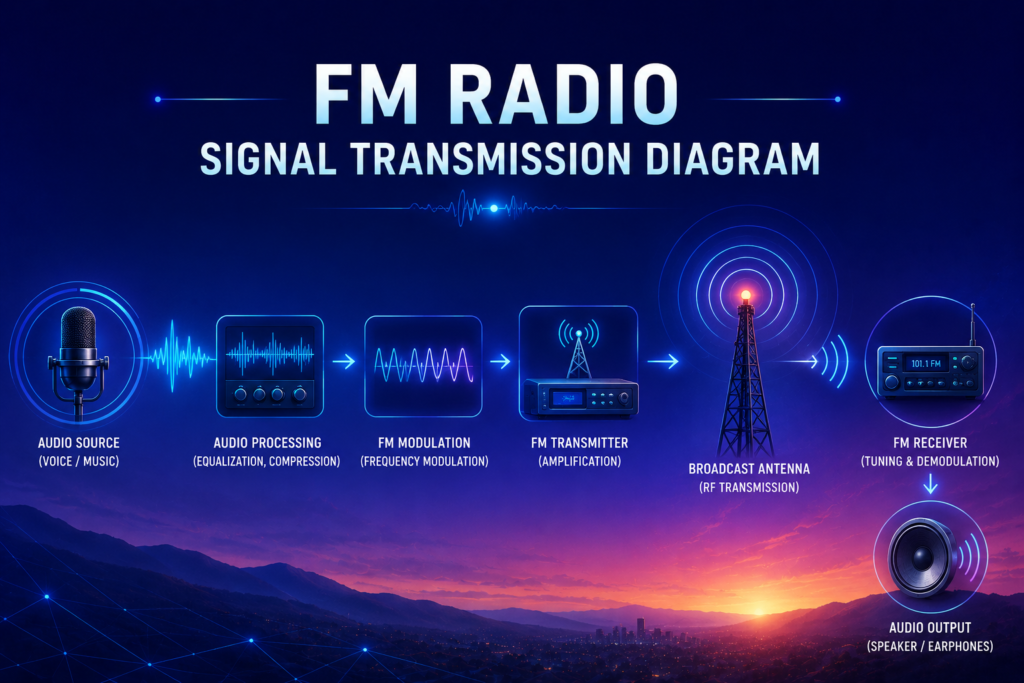
Several technical elements impact the excellence of voice transmission in FM broadcasting. Engineers constantly optimize these variables to make certain everyday listener evaluations. Signal first-rate depends on transmission power, antenna overall performance, audio processing, receiver sensitivity, and environmental conditions. Maintaining the right balance among those factors is crucial for powerful broadcasting.
Common Sources of Signal Degradation
Interference from close-by digital gadgets can have a notable effect on the sign. Although FM generation is proof against many forms of noise, extreme interference can also, moreover, affect reception.
Distance from the transmitter can also reduce sign power. As listeners pass farther away, the signal will become weaker and extra at risk of environmental elements.
How Modern Technology Has Improved FM Broadcasting?
Modern FM broadcasting structures contain virtual equipment that increases reliability, overall performance, and audio bests. Advanced audio processors, automated monitoring systems, and precision transmitters have drastically more broadcast everyday overall performance.
Many stations now combine virtual workflows even while continuing to use FM transmission for massive goal marketplace benefit. This combination of conventional broadcasting and modern-day technology allows FM radio to remain applicable in the modern media landscape.
Future Innovations in FM Broadcasting
Emerging technology continues to enhance sign processing, transmission performance, and listener memories. Hybrid radio structures are combining FM broadcasting with internet-based, definitely complete offerings to offer additional content and interactivity.
As broadcasting technology evolves, the vital mind in the back of voice transmission lives unchanged. The technology advanced a few years in the past, however, and serves as the muse for modern FM communication structures.
Conclusion
Understanding The Science Behind Voice Transmission in FM Broadcasting fame is the outstanding adventure a human voice takes from a microphone to radio listeners. Through sound wave conversion, audio processing, frequency modulation, service wave transmission, antenna broadcasting, and receiver demodulation, FM radio offers smooth and reliable conversation throughout extensive distances.
The continued fulfillment of FM broadcasting demonstrates the effectiveness of these scientific requirements. Even within the virtual age, The Science Behind Voice Transmission in FM Broadcasting remains a captivating instance of engineering innovation that maintains connections between groups, informs audiences, and entertains masses of heaps of listeners globally.
Explore Our Recent Blogs
- How FM Radio Frequencies Are Assigned in India?
- What Happens Inside a Radio Broadcasting Studio?
- How Live Radio Shows Are Broadcast Without Delay?
- Why FM Radio Still Works During Emergencies and Disasters
- How Regional Language Content Is Decided on FM Stations?
Frequently Asked Questions
1. What is voice transmission in FM broadcasting?
Voice transmission in FM broadcasting is the system of converting spoken audio into electric signs and signals, modulating the ones’ indicators onto a radio frequency carrier, transmitting them through antennas, and reproducing them via radio receivers. This method allows listeners to pay attention to the precise voice over prolonged distances.
2. Why is frequency modulation used in FM radio?
Frequency modulation is implemented in FM radio because it gives advanced audio first-rate assessment compared to amplitude modulation (AM). It is a first-rate deal less affected by electric interference, static, and environmental noise, ensuing in clearer sound. This makes FM broadcasting best for transmitting music, voice, and specific moderate-fidelity audio content material.
3. What role does a microphone play in FM broadcasting?
A microphone serves as the starting point of the broadcasting device with the aid of capturing someone’s voice or considered one-of-a-kind sounds. It converts sound waves into electric-powered signals that can be processed and transmitted with the aid of the broadcasting device. Without a microphone, the audio content material could not enter the transmission chain.
4. How do FM transmitters send voice signals?
FM transmitters get a keep of processed audio alerts and combine them with an immoderate-frequency provider wave, the usage of frequency modulation. The modulated signal is then amplified to boost its power before being dispatched to a public antenna. The antenna radiates the sign as electromagnetic waves that journey via the ecosystem.
5. How does an FM radio receiver reproduce sound?
An FM radio receiver captures incoming radio waves via its antenna and selects the popular station frequency. It then demodulates the signal to get higher actual audio facts and amplifies it for playback. Finally, the audio device converts the electric indicators lower back into sound waves that listeners can pay attention to.
6. Is FM broadcasting still relevant today?
Yes, FM broadcasting remains relevant as an alternative because it offers reliable, value-powerful, and great audio transmission. Millions of humans, nevertheless, depend upon FM radio for information, tunes, entertainment, visitors’ updates, and emergency publicities. Its sizeable accessibility and reliability continue to make it a vital global conversation medium.